Community Environmental Education Project
Reforesting a native forest is not enough if we do not also teach how to care for it.
Socio-Environmental Challenges in a Rural Educational Community
Our educational community is located in a natural environment of great ecological value: the Andean Patagonian forest. Native ecosystems in this region are highly vulnerable and are increasingly threatened by the advance of three interconnected factors: forest fires, the lack of public policies, and real estate development.
In recent years, forest fires have intensified due to the climate crisis and the lack of preventive public policies. Fire degrades soils, destroys biodiversity, and reduces the ecosystem’s capacity to retain water.
This situation is further aggravated by the lack of environmental education. Many migrants arrive from large cities without sufficient environmental awareness, which can unintentionally intensify the problem. For example, some purchase land and clear large portions of native vegetation, replacing it with grass lawns or exotic species, which alters the ecological balance and weakens native ecosystems.
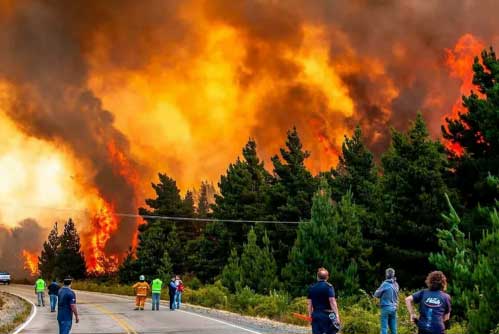
Forest fires also threaten the livelihoods of the community in a region dedicated to berry production, livestock, and tourism. Many families are economically affected by these conditions, which often forces them to prioritize meeting basic needs over socio-environmental care.
As a result, very few families in the area are able to access the socio-environmental education offered by our community. At the same time, due to the difficulty of sustaining a livelihood in the territory, many families with a strong connection to nature are forced to migrate to cities in search of work. This process leaves the territory increasingly open to real estate development that moves in the opposite direction of balanced and environmentally harmonious growth.
In this context, our educational community plays a fundamental role, not only in education but also in social and cultural support, promoting values of respect for nature, community participation, and socio-environmental justice.
Project Objectives
- Educate the community about the importance of native ecosystems and how to relate to them, fostering a balanced lifestyle connected with nature.
- Expand the reach to more families in order to broaden the impact and encourage greater diversity within the community.
- Increase community engagement and influence by extending the current boundaries of the project and strengthening its presence in the territory.
Project Description
The community environmental education project is a direct response to the challenges described above. We believe that the most effective way to educate the community is by creating meaningful contact with nature.
Our main educational space focuses on early childhood, where we prioritize healthy, holistic development, respecting each child’s rhythms, interests, and needs. In this environment, children learn through direct experiences in nature, strengthening their connection with the territory and fostering a deep sense of care and responsibility for the natural world.
We believe that environmental education in childhood is essential, as it helps cultivate nature-friendly habits from an early age. It is also a powerful and meaningful way to spread knowledge, since children often influence their families and adults through their actions and attitudes.
To regenerate ecosystems, it is necessary to engage all members of the community, and people themselves are a key element in this process.
Another area of work is dedicated to the families involved in the community, through gatherings that create spaces for reflection and collective building.
All activities take place at Chacra Millalen, a space with buildings made from natural materials and immersed in a remarkable natural landscape. Here, rural activities aligned with nature are carried out, such as the production of vegetables and fruits, coexisting in harmony with the native flora of the ecosystem.
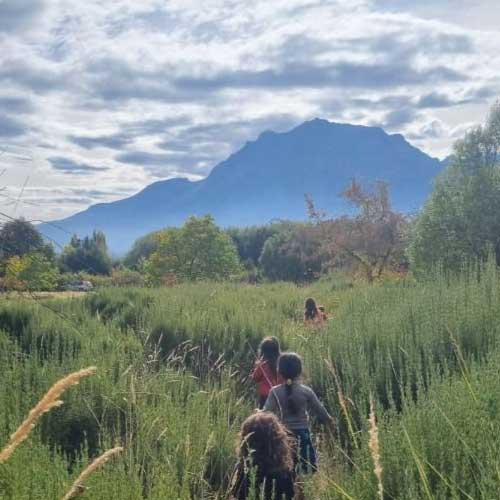
The connection with nature and its cycles is always present. A large part of the activities take place outdoors, allowing participants to experience the natural environment directly.
We also organize seasonal celebrations that bring the community together, as well as outings with families to the mountains, rivers, and lakes to appreciate and honor nature.
In addition, we carry out activities focused on the preservation of native forests, participating in reforestation outings and native seed collection.
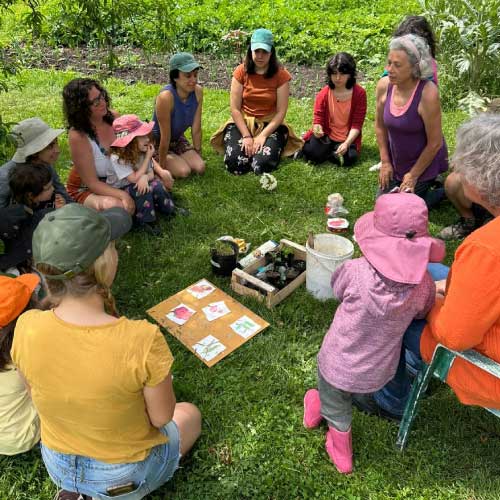
Alongside the spaces described above, we also offer workshops open to the community, such as gardening, reforestation, ceramics, natural art, weaving, and environmental education.
In summary, La Ronda is a space where children attend to grow and develop freely within a natural environment. Families take part in the process by embracing shared values through self-management and community gatherings. At the same time, the local community is positively influenced by the various initiatives promoted by La Ronda.
This represents a long-term impact, fostering community growth that directly contributes to environmental regeneration.
Two-Scholarship Program for our Nature-Based Early Childhood Space
Annual budget: USD 3,600
The scholarship program for our early childhood space aims to open the doors to families from the local community who, for socioeconomic reasons, are currently unable to participate in the project.
With this funding, two children will be able to attend the nature-based early childhood program. In turn, their families will also be able to actively participate in the various activities focused on environmental, social, and community development.
The early childhood space operates Monday through Friday for four hours each day, taking place on a spacious rural property (chacra) immersed in nature.
Main Pillars of the Space
- Free and spontaneous play:
Play is the driving force of learning, allowing children to explore and create scenarios both individually and in groups. Through play, they negotiate and resolve conflicts, express their interests, and develop creativity and autonomy.
2. Relationships and coexistence:
- Self-care: We support children in recognizing their emotions and desires, and in setting healthy personal boundaries. We encourage autonomy, self-regulation, and self-confidence.
- Care for others: We promote respectful relationships and the development of empathy.
- Care for the environment: We cultivate a conscious and respectful relationship with the natural environment, as well as responsibility in caring for shared materials.
3. Connection with nature:
Nature is a powerful regulator and a constant source of learning. Children explore life cycles and develop a deep respect for the natural world. Outdoor play is rich and diverse, strengthening their connection with nature and their understanding of the world around them.
As more families become involved in these educational spaces, the community impact grows, contributing to the deep regeneration of both society and the territory.
8 Monthly Workshops Open to the Community
Annual budget: USD 980
In addition to the early childhood space and the participatory spaces for families, we aim to develop monthly workshops open to the wider community.
As in the previous case, socioeconomic barriers often limit the participation of neighboring families. These workshops seek to make environmental and community learning more accessible.
At the same time, because these workshops require less time commitment, they allow participation from families who, for various social or personal reasons, may not choose the early childhood program but still wish to engage in activities with a strong connection to nature.
The workshops last two hours and take place twice a week for one month, with a total of eight workshops planned each year.
They cover a variety of topics such as gardening, nature-based art, ceramics, reforestation, and forest school activities. The workshops are primarily designed for children, although some of them also include participation from families. 🌱
Measurable Results
- Incorporate 15 families into the learning community over the course of one year.
- Conduct 8 monthly workshops within one year.
- Plant 300 native species during the year as part of the environmental workshops.
- Organize 4 major public events open to the entire community, focused on environmental education.
Total budget: USD 4,580
- 2 scholarships for families in the nature-based early childhood space.
- 8 environmental education workshops during the year.
If you are interested in funding this or another project, please write to comunicacion@laronda.org.ar.